
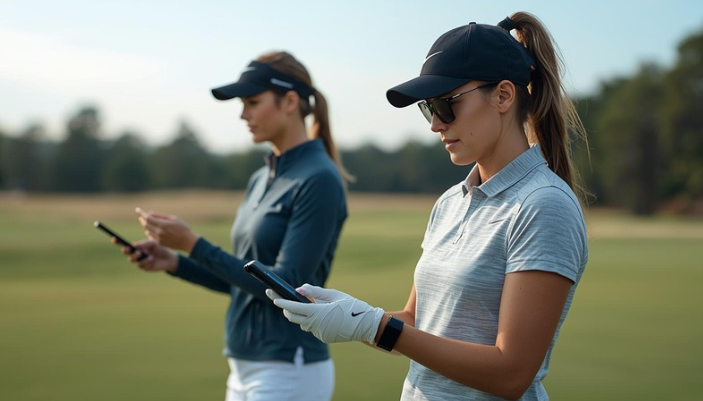
Golf performance monitors women rely on are changing how improvement happens on and off the course. Instead of guessing why shots fly too low or curve offline, you can now measure swing speed, launch angle, and contact quality in real time. Because data replaces assumption, progress becomes clearer and more intentional.
Modern training tools are no longer limited to professionals. Portable monitors, wearable tech, and app-based systems give female golfers access to detailed feedback. As a result, you can focus on what truly matters rather than chasing random swing changes.
If you want measurable improvement, understanding how to use performance technology effectively is essential. With the right monitor and strategy, every practice session becomes purposeful.
Why Measuring Performance Accelerates Improvement
Many golfers rely on feel alone. However, feel can be misleading. A swing that feels powerful may produce inefficient launch conditions. Therefore, objective data provides clarity.
Golf performance monitors women use track ball speed, club speed, and spin rates. These numbers reveal whether distance issues stem from technique or equipment.
Additionally, data highlights consistency gaps. You may strike one shot perfectly and misread overall performance. Yet monitors show average results across multiple swings.
Because improvement depends on patterns rather than isolated shots, tracking performance speeds development.
Moreover, seeing measurable gains builds motivation. Small improvements in clubhead speed or launch angle add up over time.
Types of Golf Performance Monitors Women Can Choose
Several categories exist, each serving different training goals.
Portable Launch Monitors
Portable launch monitors measure ball speed, launch angle, carry distance, and spin. Many connect to smartphones for visual feedback.
Golf performance monitors women bring to the range offer flexibility. You can analyze every club without scheduling indoor simulator time.
Some models also provide club path and face angle data. Consequently, you understand why shots curve left or right.
Wearable Swing Sensors
Wearable sensors attach to gloves, wrists, or clubs. These devices track tempo, swing plane, and backswing length.
Because they are lightweight, you can practice comfortably. Additionally, swing sensors focus heavily on sequencing and rhythm.
Golf performance monitors women use in wearable form help refine timing rather than just distance.
Simulator-Based Systems
Indoor simulators provide comprehensive analytics. While more expensive, they deliver precise ball flight simulation.
These systems often measure over a dozen variables. As a result, you gain deep insight into performance tendencies.
However, portability decreases compared to compact monitors.
App-Integrated Systems
Some devices pair with mobile apps for visual breakdowns. Charts and trend lines simplify interpretation.
For beginners, app-based monitors provide accessible entry into performance tracking.
Key Metrics That Truly Matter
Not all statistics carry equal value. Therefore, focus on metrics that influence scoring most.
Clubhead Speed
Clubhead speed directly affects distance. Even small increases produce noticeable yardage gains.
Golf performance monitors women rely on display speed clearly. Monitoring this number over weeks shows training progress.
Ball Speed
Ball speed reflects energy transfer efficiency. High club speed with low ball speed indicates poor contact.
Improving strike quality increases ball speed without extra effort.
Launch Angle
Proper launch angle maximizes carry. Too low, and distance suffers. Too high, and spin increases excessively.
Monitors reveal whether launch aligns with your swing speed.
Spin Rate
Spin controls trajectory and stopping power. Excess spin reduces roll. Insufficient spin affects control.
Tracking spin helps optimize equipment and technique.
Smash Factor
Smash factor measures efficiency. It divides ball speed by club speed.
Golf performance monitors women use often highlight smash factor as a performance benchmark.
Using Data to Guide Practice
Collecting numbers alone does not guarantee improvement. Action based on insight matters more.
After each session, review averages rather than single swings. Identify consistent patterns.
If launch angle stays low, adjust tee height or ball position. If spin appears excessive, consult equipment specifications.
Golf performance monitors women depend on allow targeted drills. Instead of vague repetition, practice addresses specific weaknesses.
Track progress weekly. Compare metrics over time.
Avoid overwhelming yourself with too many variables at once. Focus on one or two improvements per session.
Balancing Technology and Feel
While data offers clarity, feel remains important.
During practice, alternate between data-focused sessions and feel-based swings. Because overreliance on numbers may create tension, balance improves results.
Golf performance monitors women integrate successfully enhance awareness without dominating attention.
During rounds, limit checking metrics. Instead, review detailed data afterward.
Technology should support intuition, not replace it.
Equipment Adjustments Based on Data
Performance monitors often reveal equipment mismatches.
For example, if launch remains low despite solid contact, driver loft may need adjustment.
Golf performance monitors women use frequently uncover shaft flex issues as well.
If spin rates exceed ideal ranges, consider different ball types or shaft profiles.
Because data identifies inefficiencies clearly, equipment changes become strategic rather than random.
Consult a professional fitter when making significant adjustments.
Improving Consistency Through Repetition
Consistency lowers scores more effectively than occasional great shots.
Use monitors to measure dispersion patterns. Wide shot patterns indicate swing path issues.
Golf performance monitors women adopt help refine alignment and face control.
Track how often ball speed remains within a narrow range. Greater consistency signals progress.
Repetition under feedback builds muscle memory faster than unstructured practice.
Mental Benefits of Measurable Progress
Seeing improvement numerically boosts confidence.
When clubhead speed increases by two miles per hour, motivation rises. Because progress feels tangible, commitment strengthens.
Golf performance monitors women use consistently provide evidence of growth.
Additionally, objective data reduces emotional reactions to poor rounds.
Instead of assuming regression, you analyze whether metrics truly declined.
Clarity replaces frustration.
Choosing the Right Monitor for Your Needs
Consider your primary goal before purchasing.
If distance improvement ranks highest, select a monitor emphasizing ball speed and launch metrics.
Golf performance monitors women should match skill level and budget.
Portability matters for outdoor practice. Indoor players may prefer simulator-based systems.
Battery life, ease of setup, and app compatibility also influence satisfaction.
Read reviews and test usability if possible.
Common Mistakes When Using Performance Tech
Chasing perfect numbers creates unnecessary pressure.
Golf performance monitors women use effectively serve as guides, not judges.
Another mistake involves ignoring trends. Single-session data rarely tells the full story.
Additionally, avoid switching drills too quickly. Consistency in practice builds clearer comparisons.
Finally, remember that improvement takes time.
Long-Term Growth Through Smart Tracking
Over months, patterns emerge.
Seasonal comparisons reveal strengths and weaknesses.
Golf performance monitors women rely on store historical data. Therefore, long-term tracking becomes easier.
Use this data to set realistic goals.
Incremental improvements accumulate steadily.
Progress supported by evidence feels sustainable and motivating.
Conclusion: Measure What Matters, Improve What Counts
Golf performance monitors women incorporate into training routines provide clarity and direction. Instead of guessing, you measure key variables that influence distance and accuracy.
Focus on meaningful metrics such as ball speed, launch angle, and consistency. Then, translate insights into structured practice.
Balance technology with feel. Use data wisely rather than obsessively.
When measurement guides improvement, confidence grows naturally.
With the right monitor and thoughtful application, every swing becomes a step toward better performance.
FAQ
- Are performance monitors useful for beginners?
Yes. Even basic metrics help new players understand distance gaps and contact quality. - Do I need an expensive system to improve?
Not necessarily. Many portable monitors provide valuable insights at moderate prices. - How often should I review my swing data?
Review data after each session and track trends over several weeks. - Can monitors replace professional lessons?
They complement lessons but should not replace expert guidance entirely. - What metric should I focus on first?
Clubhead speed and ball speed usually provide the most immediate insight.