Effective golf practice drills give you a task, a way to observe the result and a reason to choose the next task. A large bucket alone gives you none of those things. If you leave the range remembering only your best drive, it is difficult to know what to work on next. A smaller session with clear questions can be easier to understand and repeat.
This guide offers a practical set of exercises for women golfers who want structure beyond hitting the same club from the same spot. You can use them on a permitted practice green, at a range or in a safe home space. The exercises are examples to adapt with an instructor. They do not promise a score change, diagnose swing faults or require a specific level of strength.
Choose one problem you can describe
Start with an observation from a recent round: putts often finished short, a pitch carried farther than expected, or an approach began left of the intended target. That is more specific than “everything needs improving.” Choose one task connected to that observation and write it at the top of a note. If you do not understand the cause, the task can simply be gathering clearer observations.
Distinguish a technical lesson from a test of what you already know. When your coach has given you a change to learn, practise that change as instructed. When you want to test how you play, use a target and your normal routine. Mixing several new swing ideas into every test makes it hard to tell what you are evaluating.
Drill one: build an alignment station carefully
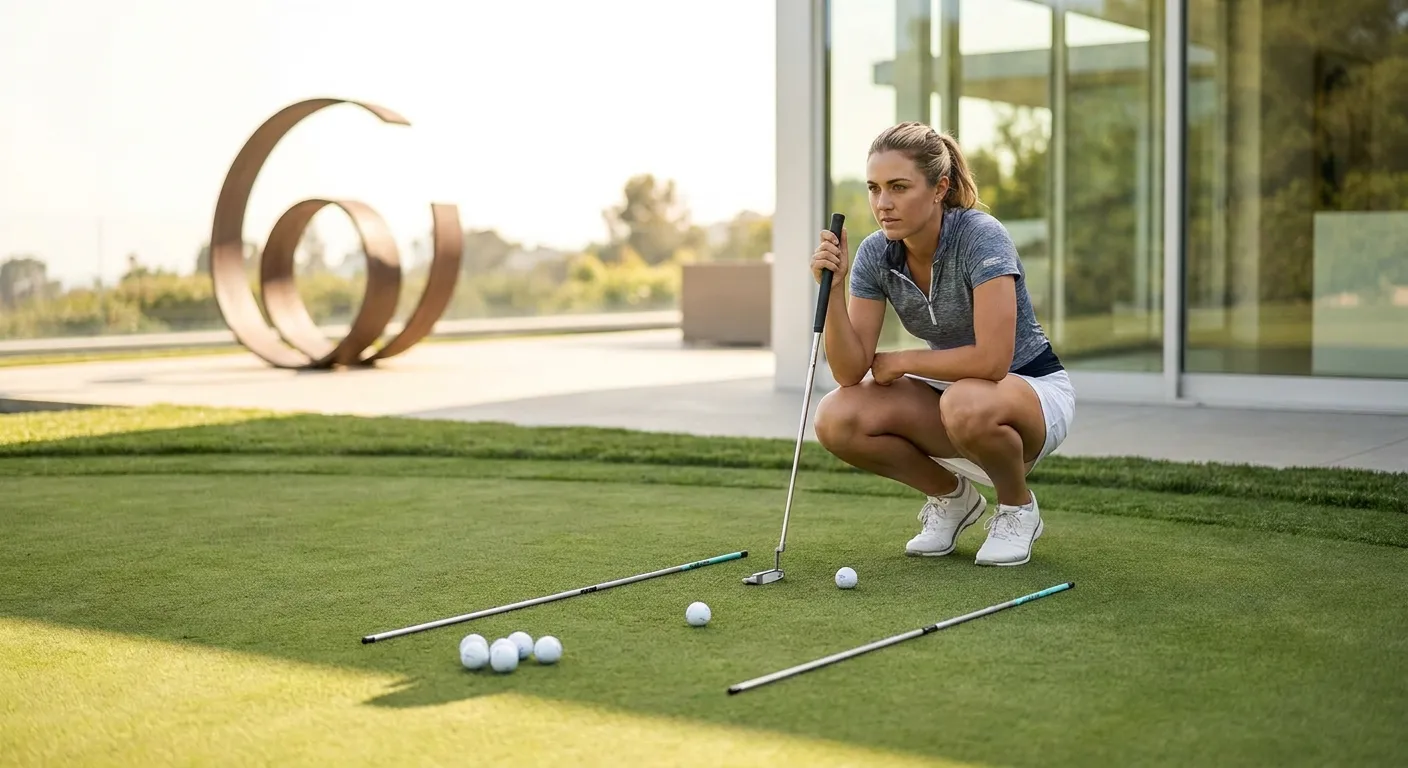
At a designated hitting bay, choose a distant target and identify its start line. Place a club or permitted alignment aid safely beside your stance, outside the path of the swing. Check the facility’s rules before using an aid. Aim the clubface first, then arrange yourself around that aim. A camera or instructor can help you compare the intention with the setup.
Hit a few shots and note their initial direction. Do not automatically interpret every left or right shot as an alignment problem; face angle and swing delivery also matter. Remove the aid and repeat the routine. The comparison asks whether you can organise the setup independently. It is not a competition to make every shot perfectly straight.
Drill two: change the target between shots
Choose two or three safe range targets that you can identify clearly. Use the same club, but select a different target before each shot. Step away, decide where you want the ball to start, and complete a fresh routine. Notice whether changing the destination changes your preparation or leads you to rush.
Record whether you actually aimed at the chosen target and whether the ball started in the intended direction. You can use simple categories such as left, near the intended line and right. The categories are personal observations rather than a formal measurement system. Use them consistently within the session and take any persistent pattern to a coach.
Drill three: create a wedge landing ladder
Choose several landing areas at different distances in a permitted short-game space. Start with the nearest, then move outward, using one wedge and comfortable motions. Pay attention to the first landing point rather than where the ball finally stops. Keep people and equipment outside the shot area, and do not use a putting-only green for this exercise.
The PGA of America’s landing-zone practice lesson provides an example of organising a pitching task around where the ball lands. Your ladder can be simpler: select generous areas and learn what your current motion produces. These are your practice distances, not targets every woman golfer must reach.
Change the order once you are comfortable with the task. Near, far and middle requires a fresh decision, while repeatedly moving farther can let rhythm replace judgment. If the exercise becomes confusing, reduce the number of zones. Make the task understandable before trying to make it difficult.
Drill four: putt into a finishing area
On a practice putting green, choose a long putt with room beyond the target. Imagine a broad finishing area around the hole, or use permitted markers if the facility allows them. Roll a few balls with the goal of finishing in that area. Note whether they are consistently short, long or spread across both sides.
Repeat from a different direction rather than assuming the first result tells you the whole green’s speed. Uphill and downhill putts can ask different questions. You do not need a precise success percentage to learn something useful; a note such as “downhill distance was difficult to judge” can identify the next practice task.
Drill five: check the start line of a short putt
Select a short putt you can practise without blocking other players. Choose a clear intermediate point along the intended line and focus on rolling the ball over it. If you use a gate made from tees, place it only where the facility permits and keep it wide enough for a learning task. Avoid creating a narrow obstacle that turns every small miss into frustration.
Compare the ball’s start with the read you chose. A putt that starts on your intended line and misses can still teach you about the read or speed. A made putt does not prove the read and stroke were ideal. Separating the decision from the result keeps the exercise more useful than simply counting holes made.
Drill six: play a pretend hole at the range
Picture a hole you know and choose a tee-shot target suited to it. Hit one ball with your normal routine. Then select the club and target you would use for the next shot, considering where the first ball went. Finish with a wedge task if the space allows it. The exercise practises changing jobs instead of repeating one motion until it feels comfortable.
Keep the imagined hole realistic. Do not give yourself a perfect lie after every miss or turn every second shot into a driver. If your tee shot would have required a recovery, choose a shorter target and practise that decision. You are exploring course management without claiming the simulation reproduces the course exactly.
Use home practice for tasks the space can support
A clear indoor floor may allow putting practice with a safe target, but it does not automatically allow full swings. Check ceiling height, surrounding objects and where a ball could travel before beginning. Keep children, pets and other people out of the activity area. If the space is unsuitable, use it for reviewing notes or rehearsing your decision routine without a club.
A mirror or phone can help you observe setup if positioned securely. Compare recordings made from the same angle and avoid treating a distorted camera view as a technical diagnosis. Ask your instructor what the recording is meant to show. A single useful view is more manageable than collecting many clips you do not know how to interpret.
Keep practice separate from competition
Training aids and extra practice strokes can be restricted during a round. The USGA’s practice FAQ explains limited practice before or between holes in match play, subject to Committee instructions. Its equipment guidance under Rule 4.3 also addresses uses of training aids. Check the current rules for the format you are playing.
For learning, use the dedicated practice facilities and follow their local instructions. Do not practise an exercise while another golfer is preparing to hit through the same space. Return the area to the condition you found it, collect your equipment and leave any shared markers where they belong.
Put the exercises into a short session
A sample session can have four parts: settle in with comfortable preparation, work on one selected task, change targets to test it, and write one observation before leaving. This is a framework rather than a timed prescription. If you have less time, shorten the repetition stage rather than removing the question and the review.
Stop when tiredness or discomfort makes the exercise unsuitable, and seek appropriate help for pain. This article is general information, not medical advice. There is no need to complete an arbitrary ball count. Your record should tell you what you attempted, what happened and what you want to ask at the next lesson.
Leave knowing what comes next
Effective golf practice drills are repeatable learning tasks, not a collection of swing secrets. Choose one question, observe the result and include a few shots that require fresh decisions. The next time you practise, compare the same task under similar conditions. That gives your golf a useful thread from the practice area to the course.